UPTURN · DIRECTOR OF UX & CREATIVE · WOMEN'S HEALTH & LONGEVITY
Brand to AI prototype in 6 months. For users navigating brain fog, a fragmented information landscape, and a medical system that had largely stopped listening.
How might we build a precision health platform that could serve as both educator and advocate for women whose care system had left them without either?
6
months from ground zero to working prototype
founding team, building brand, UX, AI conversation design, and user research simultaneously
1
The situation
Women navigating perimenopause and menopause were on their own. Not because they weren't trying. The research revealed that even the most proactive, health-literate women in this phase were scrambling: piecing together information from Instagram and TikTok, fighting their providers for testing and hormone support, being dismissed or underdosed by clinicians who simply didn't have the training to help them.
The information existed. The science was there. What was missing was any reliable way to get it to women in a form they could actually use while experiencing brain fog, mood shifts, and fatigue.
The research changed what we thought we were building. A symptom tracker wasn't enough. Women needed a partner that could educate them on what was happening in their bodies and help them advocate for themselves in clinical settings where they were routinely underserved. The product had to do both.
✹
What I owned
I was on the founding team from the beginning, before the company had fully decided to form. The initial design sprint I led was part of what started that conversation: validating whether the space had real traction and whether there was a product worth building.
From there I owned everything: brand direction, creative leadership, user research, conversation design, wireframing, prototyping, and the management of our overseas development team.
The founders had deep technical expertise and almost no design literacy. They'd put money into creative work that hadn't landed, and needed someone who could take full command of the design direction. I stepped in as the person who could see the whole product, hold the creative vision, and direct every dimension of the experience. The title was UX Director. The scope was considerably broader.
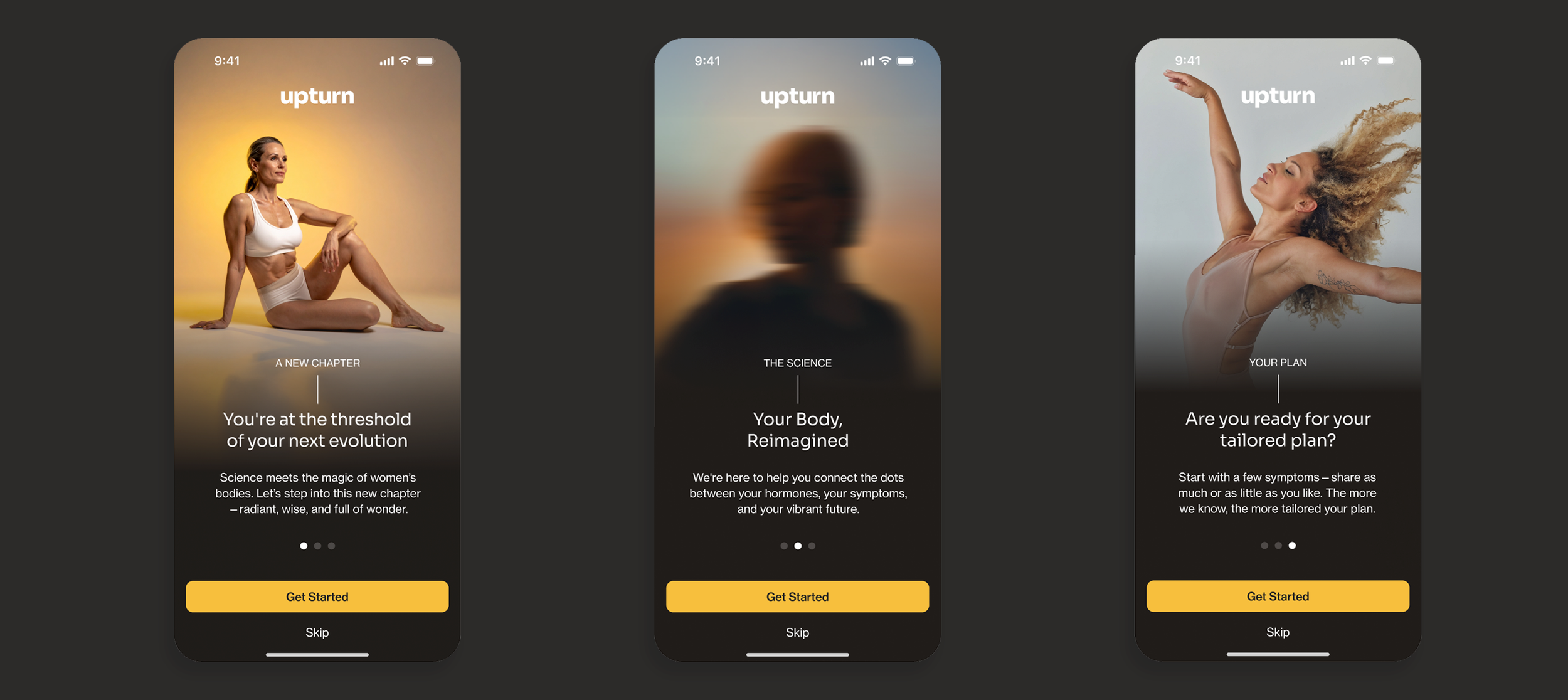
I recruited and directed the naming and branding specialist who developed Upturn's identity. I led the conversation design for the AI, including its tone, its logic, and how it would meet a user who was confused, exhausted, and looking for something she could actually trust. This was early AI-native product development, before conversation design had a widely shared playbook. I prototyped with AI development tools before that was common practice.
I also led the early design sprints that validated whether the space had real traction before we built deeper into it.
✱
The constraints
The user population was the hardest design constraint. Women in perimenopause and menopause are frequently experiencing cognitive symptoms: brain fog, difficulty concentrating, memory lapses. Designing an AI health platform for users whose core symptoms include cognitive impairment requires a different level of clarity, patience, and structural simplicity than most product work demands.
The clinical complexity was real. Translating the canon of leading physicians in the longevity and hormonal health space into bite-sized daily content, without losing accuracy or talking down to women who were already highly informed, required constant judgment about what to include, what to simplify, and what to hold back.
We were building fast, with a lean team, an overseas development pipeline, shifting priorities, and a budget that required constant triage.
✥
The trade-offs
The central tension was depth versus accessibility. The science of precision medicine and hormonal health is genuinely complex. Women in this phase deserve the full picture. They also can't absorb a research paper at 3am when they can't sleep and don't know why.
Every content and UX decision was a negotiation between those two things: rigorous enough to be trustworthy, clear enough to be useful on a bad day.
The product has since pivoted from consumer-facing to physician and client-facing. That pivot reflects something the research made clear early: women need a clinical partner in the room, and the platform is most powerful when it's connecting users to that care rather than trying to replace it. The design work I built holds up across both models because it was always built around the user's actual experience, not a single go-to-market assumption.
❉
What this unlocked
Women's hormonal health is one of the most underfunded, underresearched, and underdesigned spaces in medicine. The work I did at Upturn sits at the intersection of AI, precision medicine, and human-centered design for a population that has historically been dismissed by the systems meant to care for them.
Getting this right matters. When the design fails, real people get worse care. That's what makes this work worth doing carefully, and worth doing at speed when speed is what's required.
Upturn is part of a longer thread: design in service of human wellbeing, at the moments when people most need someone to have thought carefully about their experience. That's the work I keep finding, and it's the work I keep choosing.